One of the most common questions we get when kicking off a new e-commerce project is: “What system should we build this on?” Is it going to be BigCommerce, Magento, or maybe Shopify?
I wish I had a simple answer for you, but life’s rarely that easy – there’s no “one size fits all” here. Sorry! What we can do, however, is lean on our 15 years of e-commerce experience to break down two of the biggest players: Magento and Shopify Plus. We’ll take a look at the pros and cons, the price tags, how easy they are to use, and how well they can grow with you.
The Core Differences Between Magento and Shopify
From a business standpoint, the main thing to understand is that the biggest difference isn’t really about the code or even the customer experience. It’s about how these two platforms actually work at their core.
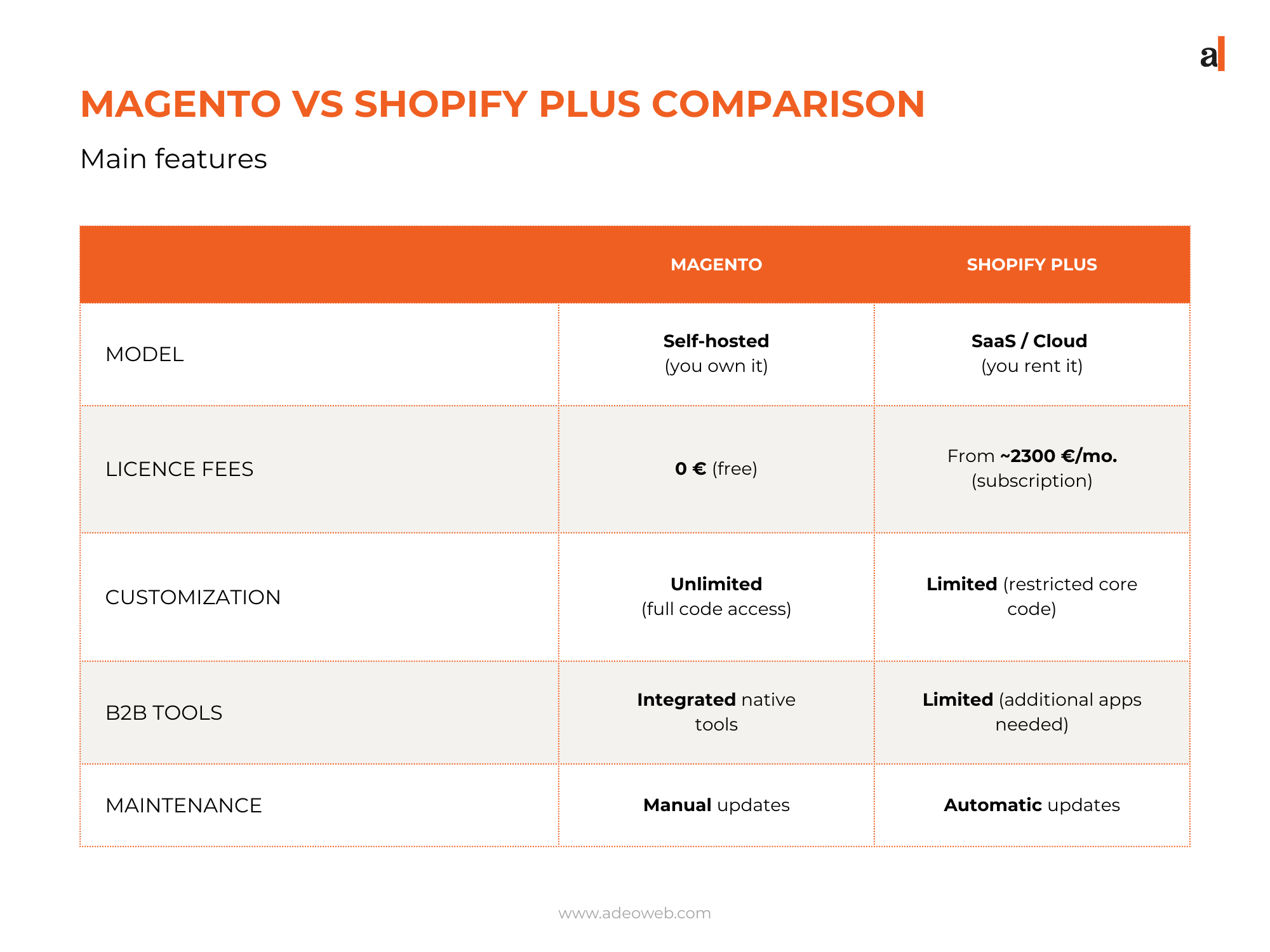
Think of Shopify as a SaaS platform – basically, it’s a “ready-to-use” product. You pay a monthly fee, and they handle all the heavy lifting like servers, configuration, and maintenance. Magento works in a totally different way. It’s an open-source system that’s completely customizable. You can host it yourself (the Open Source version) or use the Adobe Cloud (Adobe Commerce). You get way more control, but you also need some serious technical know-how to keep things running smoothly and really make the most of it.
Customization is another area where they part ways. Shopify is a “closed” system. Sure, you can tweak themes and plug in apps, but you’re ultimately playing in their sandbox, you can only go as far as the developers allow. Magento, on the other hand, has no such limits. It lets you change every single line of code, meaning you can build complex, one-of-a-kind solutions and any integration you can dream up.
In a nutshell:
- Magento is the flexible powerhouse built for large-scale projects that need custom-tailored features.
- Shopify is the go-to for getting a polished, ready-made store up and running fast.
Magento vs. Shopify Price Comparison
As eCommerce providers, we’d love to say that quality is the only thing that matters and budget should never be a top priority. But we’re realists – we know that for most businesses, the cost is a massive (and often sensitive) factor.
There’s a common trend of looking at Shopify as the “budget-friendly” option. However, as our colleague Irmantas broke down in a recent Delfi article, once you dig into the pricing, those costs can snowball quickly.
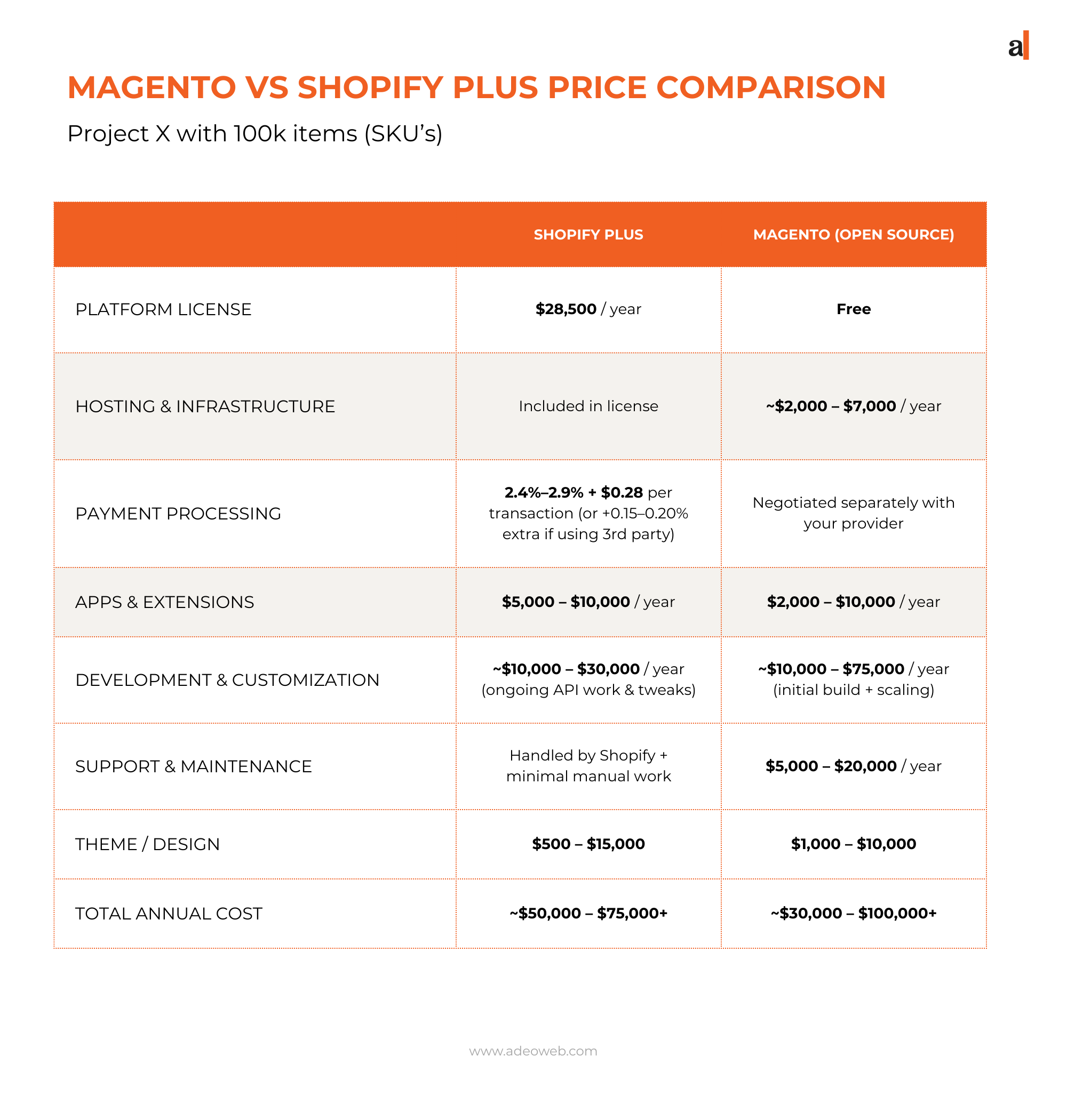
Even though a Shopify Plus subscription starts at $2,500 a month, that doesn’t include custom dev work, paid apps, or extra integrations. Plus, once your business hits a certain volume, Shopify starts taking a 0.25% cut of every single sale. To give you a rough idea: for a store with about 100,000 products, you could easily be looking at an annual bill of $50,000 to $80,000 with Shopify Plus.
Magento’s pricing is a bit more straightforward. The base version is open-source and free, and most extensions don’t come with a recurring monthly fee. This means the bulk of your investment goes directly toward hiring Magento specialists to build and maintain the site.
Of course, developer rates vary depending on the market and the agency. But using that same 100,000-product example, a Magento store could cost you anywhere from $30,000 to $120,000 initially, depending on how custom you want to go.
Performance comparison: Can Magento Keep Up with Shopify?
Let’s be honest: this is a sensitive topic for Magento veterans. We’ve all heard the myths – that Magento is “clunky,” “slow,” or impossible to optimize. But having launched dozens of Magento projects that hit top-tier performance standards, we can tell you the truth: quality development requires professionals. Speed isn’t a limitation of the platform itself; it’s a reflection of the specialists working on it.
With Shopify Plus, performance is out of your hands. That’s a double-edged sword: it’s great because you don’t have to worry about server speed, but it’s a downside because you’re stuck within Shopify’s limits – you can’t push it to “unseen heights” even if you wanted to.
“The biggest hit to speed (or lack thereof) usually comes from poorly coded third-party plugins and messy custom features. When the code quality is high, Magento isn’t naturally slower than its rivals. #Skillissue.” — Dovydas Altaravičius, CTO at Adeo Web
Which platform is Easier to Use?
Shopify’s biggest ace has always been its simplicity. Along with Wix and Squarespace, it popularized the idea that a small business owner with zero coding skills could build, maintain, and run their own shop.
This is perfect for small stores with a simple catalog and standard features. Recently, Shopify Plus has started targeting bigger brands. While it’s more complex than the basic version, it still prioritizes “user-friendliness,” meaning larger teams can theoretically manage their own e-commerce processes without a dev team on standby.
Magento, however, has a much steeper learning curve. It’s better suited for companies that already have (or can hire) experienced developers. While it has solid tools for managing content and products, any significant technical changes require specific expertise.
When it comes to apps, Shopify has a great app store with “one-click” installs, but your options for customization are limited. Magento’s massive marketplace, years of history, and open architecture offer far more freedom for deep integrations and unique features.
Long-Term eCommerce Development
People often ask us about the future of Magento and whether it will still be supported years from now. Shopify Plus is the “new kid on the block,” aggressively chasing mid-sized businesses. Magento, on the other hand, is the industry veteran with over a decade of dominance. Today, both systems sit at the top of the leaderboards.
While Shopify Plus spends a ton on marketing to attract new users, Magento still powers some of the world’s biggest brands – think Nike, Tommy Hilfiger, Nintendo, Helly Hansen, and National Geographic.
Plus, the Magento community is incredibly active. Between MageOS (a community-driven branch ensuring long-term compatibility), Hyvä (a game-changing solution that makes Magento’s front-end incredibly fast and modern), and global “Meet Magento” conferences, the ecosystem is very much alive.
So, Which One is Actually Better?
Let’s look at the scoreboard:
Shopify Plus is best for:
- Smaller businesses that want the simplest experience possible.
- Teams that want to handle most of the e-commerce management in-house.
- Businesses that don’t mind working within a “closed” system’s limits.
Magento is best for:
- Mature, complex projects where “no limits” is a requirement.
- Businesses that need a system tailored exactly to their unique logic.
- Large-scale operations where e-commerce is a primary revenue driver.
While Shopify Plus is a slick, modern tool, we often hear from clients that the “marketing promises” didn’t quite match reality. The low initial costs can balloon with extra fees, and the subscription model means you’re locked into those costs forever. Often, a business will have a specific need that the system simply can’t handle because it’s closed off.
Magento is the seasoned pro. Development requires high-level skills, but the result is a long-lasting asset that you actually own. With the right support, a Magento store can handle massive traffic and complex growth for years to come.