One of the more popular platforms for building online stores in the Baltic region is Sylius, an eCommerce solution that originated in neighboring Poland. We’ve used it to deliver several eCommerce projects for our clients, and it’s a platform we’re frequently asked about. So today, we’d like to share our experience, compare Sylius with the well-known market leader Magento, and assess which solution might be the better fit for your specific project.
Let’s go?
Key Differences in Functionality Between Magento and Sylius
Let’s take a brief look at the core characteristics of each platform: flexibility, built-in features, performance, and the type of business each one is best suited for.
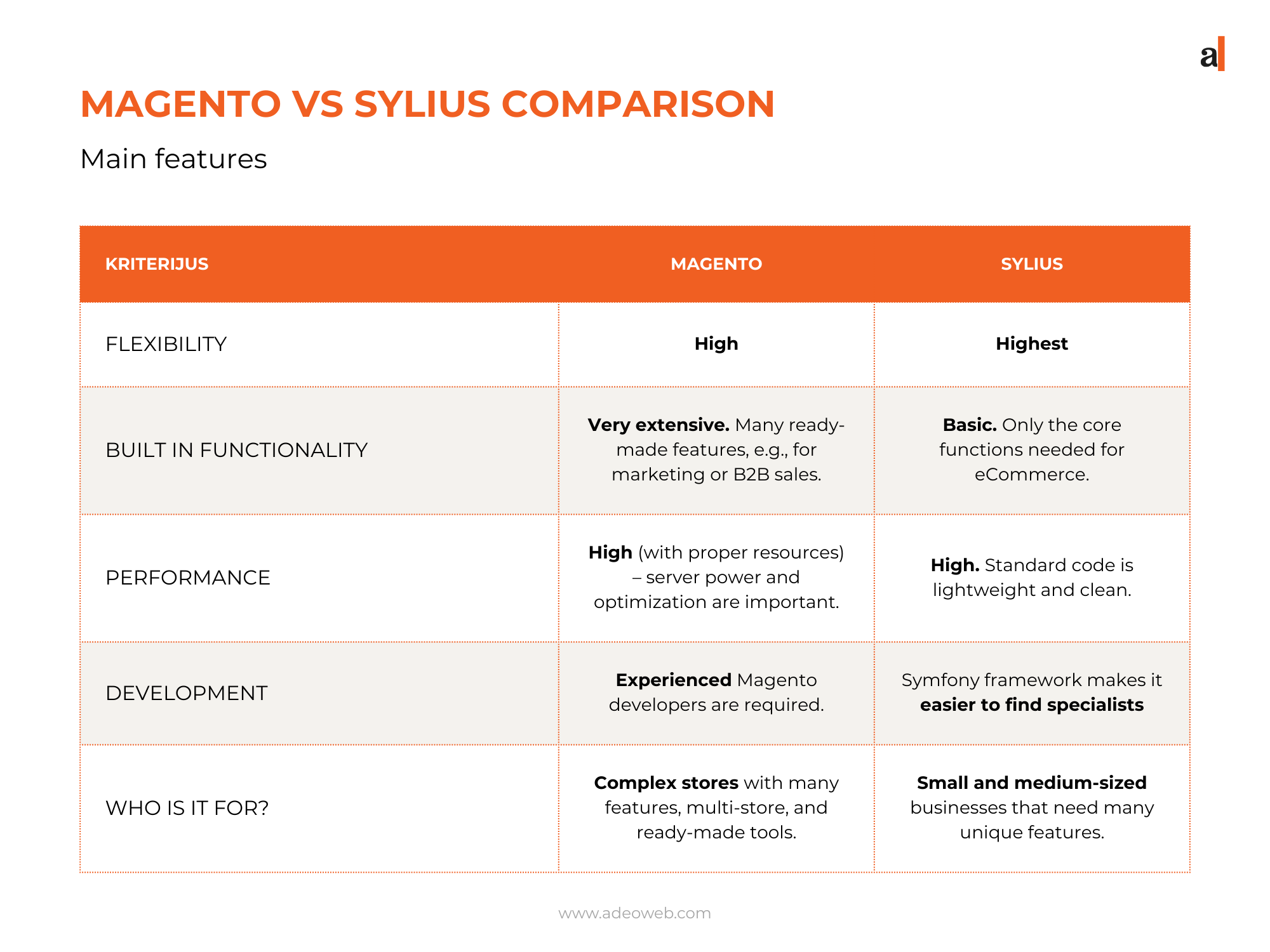
To begin with, Sylius was designed as a next-generation eCommerce framework, offering a lightweight foundation for online retail. In practice, this means its architecture is clean, modern, and fast. Sounds great, right? However, it also means that Sylius focuses primarily on core eCommerce functionality. If you need to go beyond that, you’ll likely require custom development or additional plugins.
By contrast, the long-established market player Magento comes with a broad range of built-in features: catalog management, promotions, multi-store capabilities (supporting multiple languages and currencies), SEO tools, and more. These can be used out of the box, without the need for extra development. Magento also offers integrated B2B functionality (in its Enterprise edition), making it particularly relevant for wholesale and more complex business models.
Which Platform Is Faster to Develop?
Magento development is typically fast when project requirements align with its built-in features. However, once you move beyond standard functionality, timelines can expand. With Sylius, development often starts more slowly, since many elements need to be built from the ground up. Over time, though, the pace usually accelerates as the system is shaped precisely around the project’s needs.
It’s also worth noting that Sylius follows a modular architecture and is built on Symfony components, which allows for tightly controlled and highly structured extensibility.
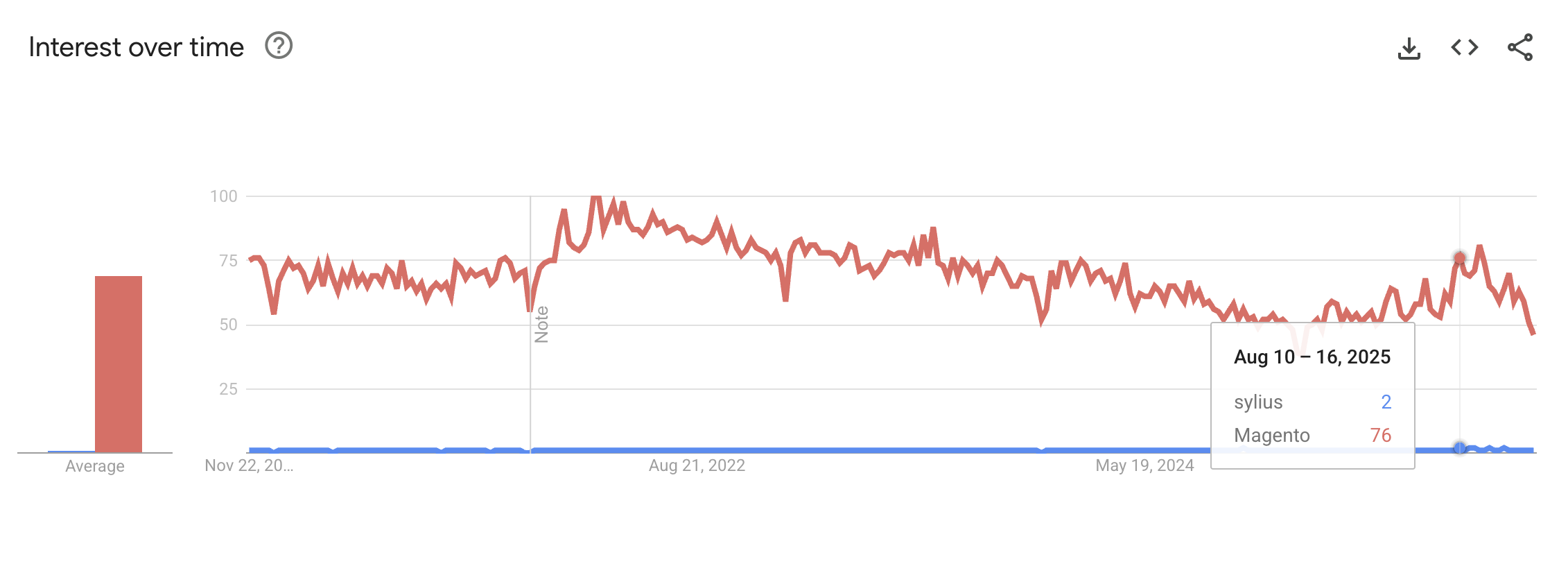
Although Sylius is relatively well known in our region, on a global scale it remains a niche player. Its adoption is significantly smaller than Magento’s. According to Gate Software, there are around 250,000 active online stores running on Magento worldwide, compared to roughly 2,500 built on Sylius. BuiltWith database shows similar results.
Performance Comparison: Which Is Faster – Magento or Sylius?
As we’ve mentioned more than once, the myths surrounding Magento’s “lack of speed” are often overstated. That said, achieving strong performance with Magento does require substantial resources – robust hosting and careful optimization, especially as traffic volumes or product catalogs grow. In practical terms, this can make maintenance more technically demanding and potentially costly.
Sylius, on the other hand, features a lighter, modular architecture that runs efficiently even on relatively simple infrastructure. Its streamlined design allows it to adapt smoothly if requirements suddenly scale. Because it’s built on Symfony, developers can fine-tune performance without being constrained by the limitations of a complex monolithic system. As a result, long-term maintenance tends to be more straightforward – particularly as the project expands or custom solutions are introduced.
Let’s talk money: Magento vs. Sylius Cost Comparison
Naturally, one of the key questions when choosing a platform for a new e-commerce project is cost. To make the comparison more tangible, let’s look at a hypothetical Project X with 100,000 unique SKUs and examine how Magento and Sylius might differ in terms of investment.
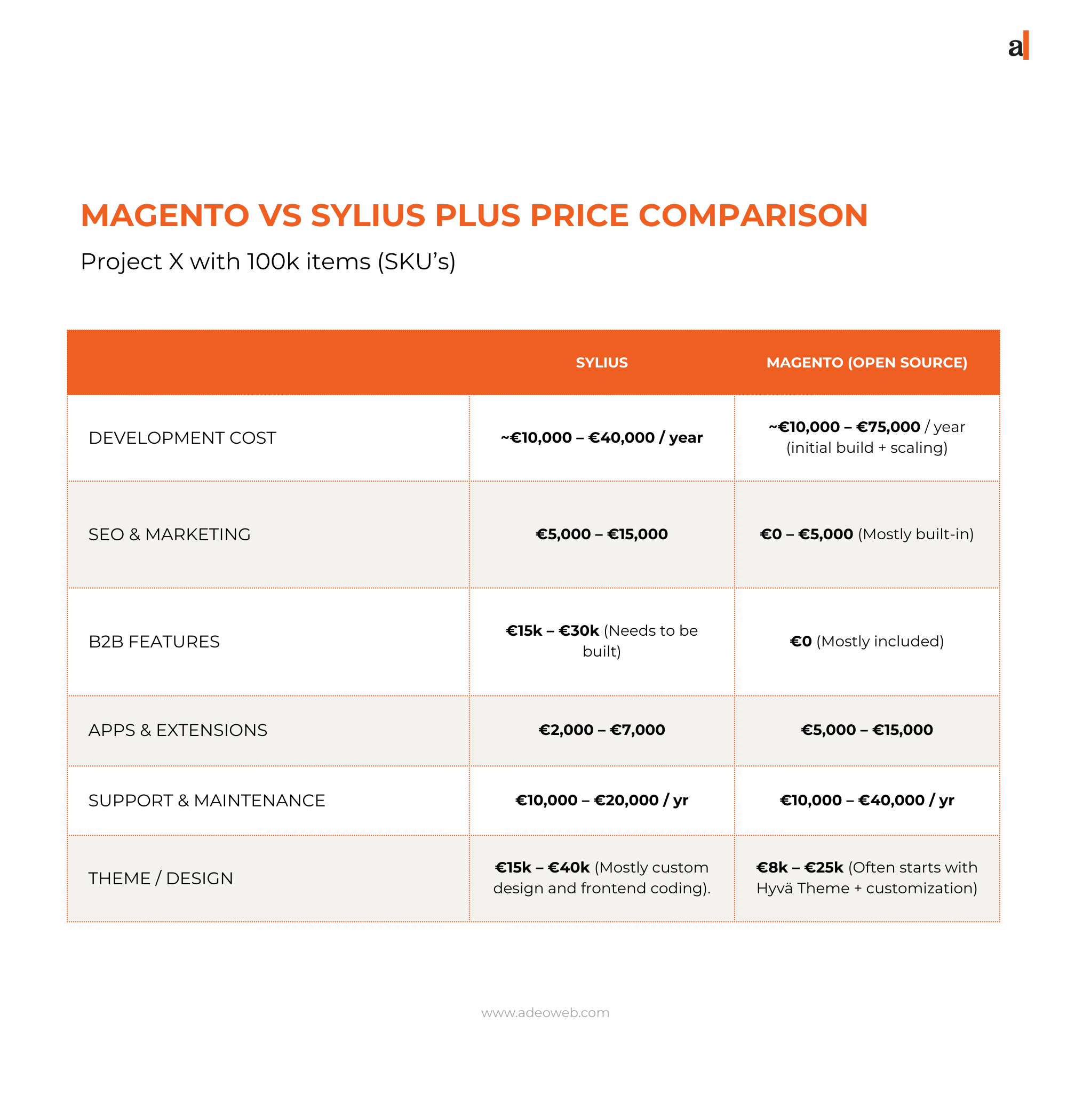
At first glance, Sylius may seem like the more affordable option. Initial development costs are often lower, and the platform itself feels lighter. However, that impression can shift quickly once you assess what’s included out of the box and what needs to be built from scratch.
SEO capabilities, marketing tools, and easily deployable B2B functionality are where the difference becomes most apparent. With Sylius, these elements typically turn into custom development projects, which can drive costs up quickly. Magento addresses most of these core requirements natively.
A similar pattern appears in design, extensions, and ongoing support. Sylius offers a high degree of flexibility — but flexibility comes at the expense of time and development effort.
In short, if cost is a primary decision factor, it’s essential to carefully map out your required feature set before starting development. Evaluate which platform already covers your needs and which will require additional customization. Magento tends to be more cost-effective when the functional scope is broad, while Sylius can be the more economical choice for projects with relatively standard requirements.
Ecosystem, Community, and Long-Term Support of the Platforms
A brief philosophical note: one of the most critical factors in any IT project is long-term support. Even the most impressive solution, if neglected, gradually loses its value and becomes impractical. This consideration is just as important when selecting an eCommerce platform.
Magento holds a clear advantage here. It has a long track record, a broad ecosystem, an extensive marketplace of modules, and a large network of agencies continuously contributing to its development. That said, finding developers with deep Magento expertise is not always easy – truly experienced specialists are relatively scarce.
Sylius, by comparison, operates within a smaller ecosystem, with fewer ready-made modules and fewer agencies focused exclusively on its development. However, its foundation on the Symfony framework broadens the pool of potential developers who can work with and extend the system, which can partially offset its narrower ecosystem.
Sylius plugins: 180+
Magento extensions: 3600+
Is Magento or Sylius Easier to Use?
When it comes to day-to-day store management, Magento offers a wide range of built-in administrative tools – including SEO controls, promotional campaigns, newsletter management, and more. However, that breadth of functionality comes with a learning curve. Store managers typically need time and training before they can confidently make full use of the system’s capabilities.
Sylius, by comparison, provides a less complex administrative environment. New users tend to find it easier to navigate at first. The trade-off is that it includes fewer built-in features, so implementing more advanced functionality often requires additional development and UX/UI work. Ultimately, the usability of those custom features depends on how well they are designed and implemented.
Sooo… Which Is Better — Magento or Sylius?
Ok, enough yapping. Time to count the score draw TLDR conclusions.
Magento is best suited for:
- Established market players with complex commerce operations. For example, businesses managing large product catalogs, multiple warehouses, physical retail locations, B2B pricing structures, and similar operational layers.
- Companies that prefer ready-made tools. Magento comes with a rich set of built-in features and access to a vast ecosystem of prebuilt modules, reducing the need for custom development.
- Businesses seeking a highly stable system capable of handling both large catalogs and high traffic volumes.
Sylius is a strong fit for:
- Companies looking for flexibility and uniqueness. It’s particularly well suited to non-standard business models where traditional platforms feel restrictive.
- Teams that value clean, modern code – especially developers who prefer working with the Symfony framework and want to avoid heavyweight architectures.
- Performance-focused organizations that prioritize fast-loading websites and potentially lower long-term maintenance cos
Of course, there is no universally “best” platform — and that applies here as well. The right choice ultimately depends on your business and operational style. Magento is the trustworthy heavyweight for established scale. It’s a high-investment powerhouse built for complex B2B logic and massive catalogs. Perfect for those who need to grow without limits. Meanwhile, Sylius is the agile choice. It’s a clean, modern framework designed for crafting unique, custom shopping experiences that move as fast as your vision.