We often get messages from clients standing at a crossroads stuck trying to decide between different e-commerce platforms (or wondering whether it’s time to pack up and migrate). To make this choice easier, we often advice to put them side by side: how do they actually differ functionally, which one suits your goals best, how do the costs stack up, and everything in between. In today’s arena its Magento vs PrestaShop.
We’ll share our firsthand experience, and along the way, we might even solve a pressing mystery: what kind of bird is actually hiding in the PrestaShop logo? Little hint – it’s definitely not a penguin.
What is PrestaShop and what is it used for?
First off, let’s get acquainted with PrestaShop. The platform is hardly a newcomer to the e-commerce game – over 250,000 online stores run on PrestaShop today. It’s a popular, effective, and user-friendly open-source solution tailored primarily for mid-sized businesses looking to get up and running fairly quickly.
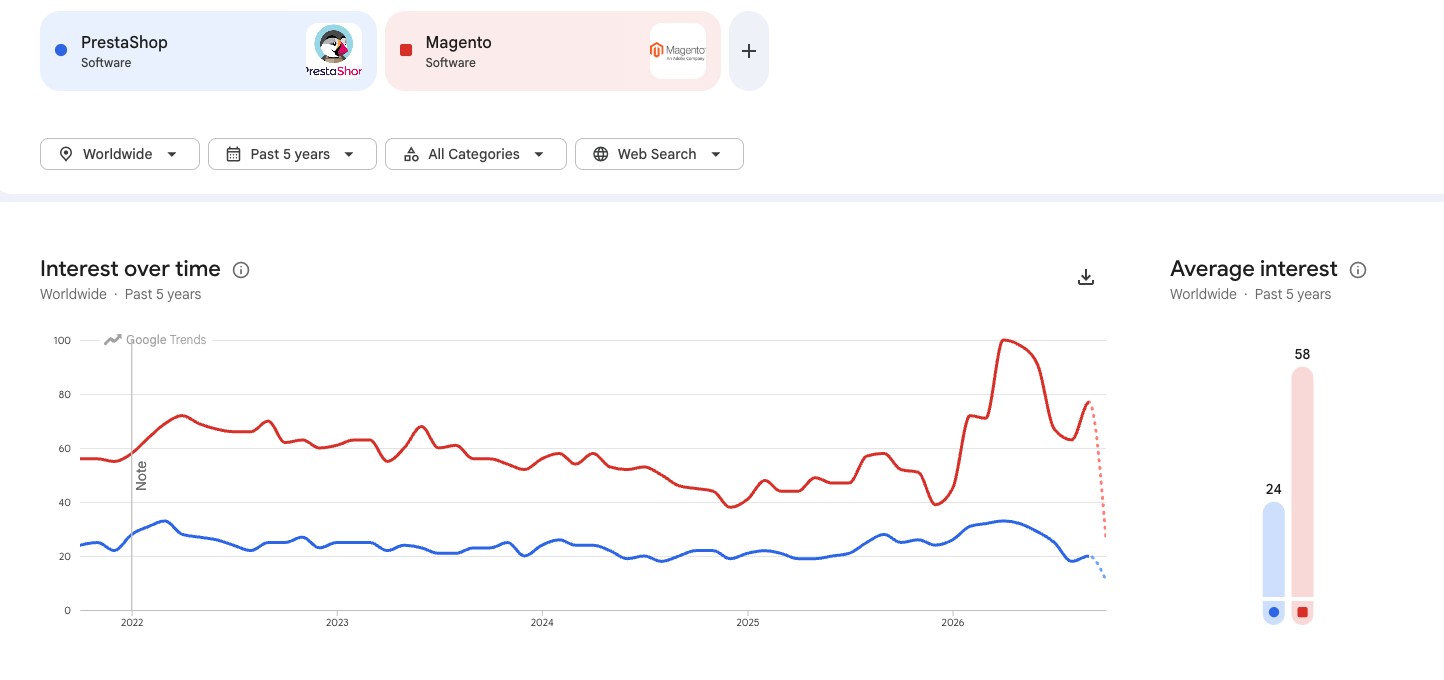
According to data from BuiltWith, PrestaShop holds a respectable fifth place among the most popular platforms:
- Shopify (19.4% market share)
- WooCommerce (8.09%)
- Shopify Plus (6.9%)
- Magento (4.26%)
- PrestaShop (2.48%)
Another bit of good news is that PrestaShop boasts an active community developing plugins that can add a wealth of features not included out of the box. To be precise, there are over 3,000 such add-ons available.
Of course, more isn’t always better. Just like we discussed in an article about WordPress or WooCommerce stores, it’s crucial to pay close attention to the quality and ongoing support of these plugins. A plugin can be a total lifesaver. Or it can become your primary source of security vulnerabilities and compatibility headaches. Be careful about it.
That said, PrestaShop’s simplicity comes at a cost. As a business grows and product catalogs expand, it’s easy to hit the platform’s limits. That’s usually when tough questions arise about complex scalability or an even more daunting migration… and that’s precisely when many store owners start casting glances toward Magento.
How do Magento vs PrestaShop features compare?
While Magento and PrestaShop might look similar on the surface, they differ significantly in both their technical underpinnings and the specific business challenges they solve.
When it comes to features, the two share plenty of common ground: both are built on PHP and both give you full ownership of your project (meaning both the open-source code and the hosting infrastructure belong entirely to you).
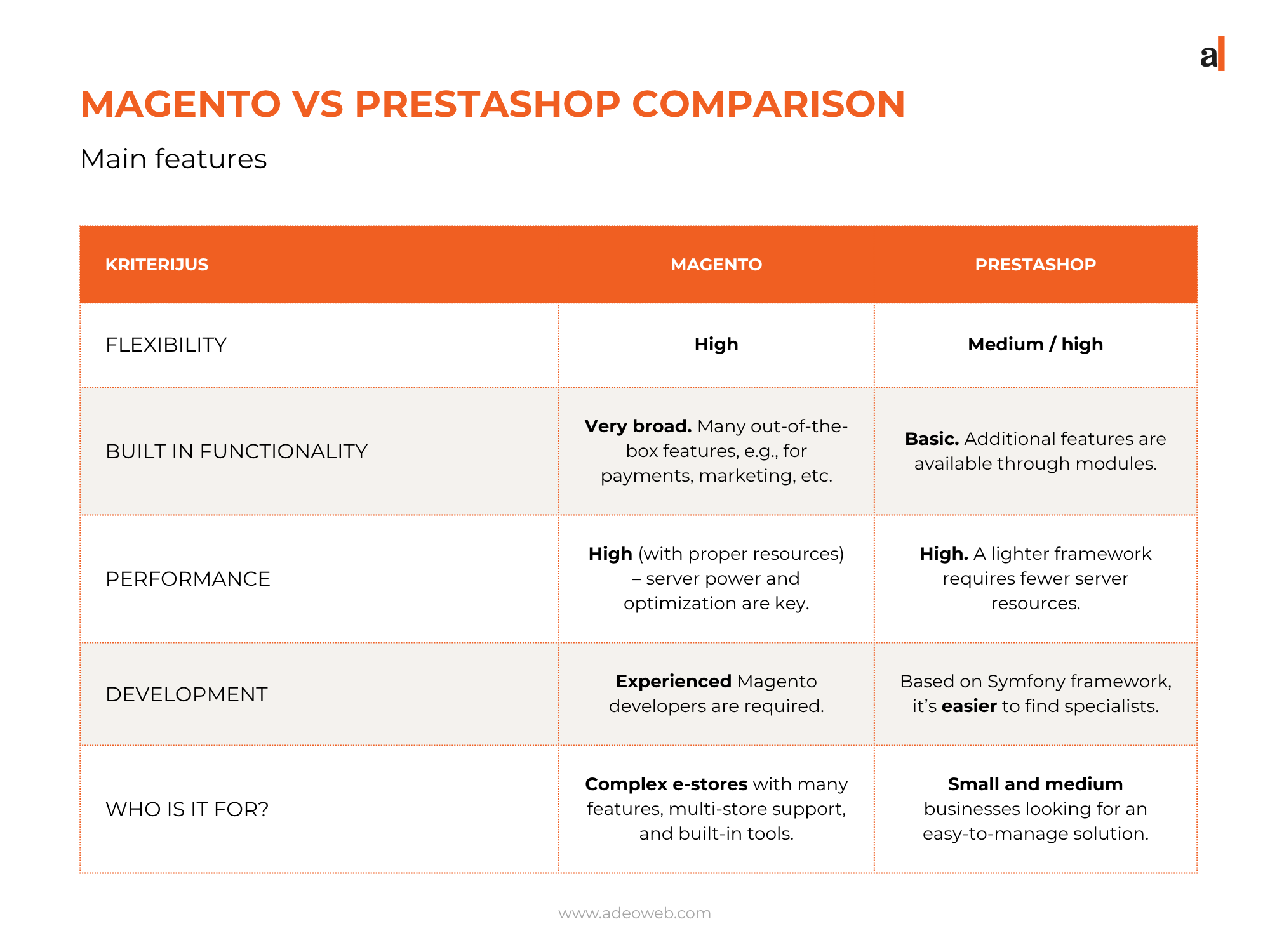
Another key factor is that PrestaShop relies heavily on add-on modules and extensions for a good portion of its functionality. For instance, while Magento natively supports most payment processing methods right out of the box (credit cards, bank transfers, Google Pay, Apple Pay, etc.), PrestaShop requires an extra plugin – like PrestaShop Checkout – to handle all of that.
At the end of the day, the key difference comes down to this: PrestaShop is built for a faster launch and requires less technical expertise.
Magento, on the other hand, is a more complex beast, but it’s engineered to handle much heavier loads – massive traffic spikes, intricate product catalogs, configurable items, complex B2B pricing structures, multi-language/multi-currency setups, and more.
PrestaShop serves difference business needs than Magento
Technical differences don’t make one platform inherently better or worse than the other. They simply serve different types of clients and distinct business needs. Any tool is only as good as how appropriately it’s used. After all, you wouldn’t use a pair of pliers to drive a nail into the wall (wait, or would you??).
PrestaShop’s primary target audience is small businesses working with limited technical budgets who still need a functional, easy-to-manage online store. It’s a great fit for standard B2C retail. If you run a single store, use a straightforward product structure, and want to hit the ground running with a reliable set of core features, PrestaShop is well worth considering.
Magento, by contrast, is usually the logical next step for mid-sized to enterprise businesses poised for rapid, aggressive growth, where high sales volumes and complex operations are on the line.
So, which is better – PrestaShop or Magento?
Time for the final verdict? Let’s break down the score for each platform.
PrestaShop:
- Fast market entry: Gets a small business selling quickly while maintaining full control over the project.
- Budget-friendly basics: Delivers essential e-commerce features without breaking the bank.
- Lower development costs: Cheaper to build, customize, and maintain over time.
In short: If your product catalog is straightforward and you’re selling from a single storefront, PrestaShop is a fantastic choice.
Magento:
- Advanced capabilities: Packed with robust features built for complex retail environments.
- Built to scale: Effortlessly handles heavy traffic, massive product catalogs, extensive attribute sets, and multi-market operations.
- Requires investment: Demands an experienced development team and a substantial budget.
In short: This is the go-to platform for businesses where e-commerce isn’t just another sales channel, but the absolute engine of the company.
P.S. By the way, that bird in the PrestaShop logo isn’t a penguin at all—it’s an Atlantic puffin!